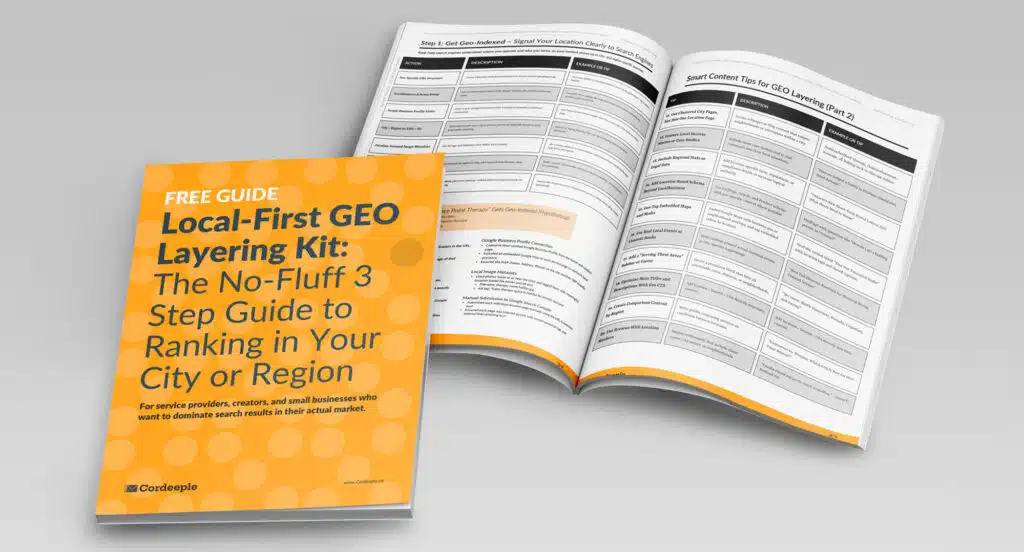
The Local-First GEO Layering Kit:The No-Fluff 3-Step System to Finally Get Found in Your Area
Want to Rank in Your City? Start Here!
Canadian Customers, Canadian Customers, Canadian Customers, Canadian Customers, Canadian Customers
Your Local Audience Is Searching.
Are You Showing Up?
You’ve built something worth finding—your services, your story, your hard-earned expertise.
But when someone googles “[your service] near me,” your name doesn’t come up. Your content’s solid, your offers are legit—but your location signals? Missing.
This isn’t a visibility issue. It’s a local clarity issue.
We won’t waste your time with another fluff-filled SEO checklist. This is a hyper-practical starter kit for service providers, creators, and small businesses who want to dominate their local market.
Inside, you’ll learn how to:
1. Get Geo-Indexed
→ Structure your site so Google knows where you operate.
(Hint: if your city’s not in your title tags, you’re invisible.)
2. Build Local Trust
→ Embed proof you actually live and work here.
Think real testimonials, local backlinks, region-aware bios.
3. Get Built to Geo-Rank
→ Create content that wins local searches (and converts).
You’ll use location-based keywords, neighborhood clusters, and action-driving CTAs that speak your city’s language.
Bonus: Smart Content Tips to Layer In
Even small tweaks can drive big impact. Start with these two:
Smart Tip #1: Start With Local Intent
→ Instead of writing for algorithms, write for how real people search.
Example: Swap “Therapy Tips” for “Affordable Therapy Halifax for Young Adults.”
Smart Tip #2: Lead With Location in Titles
→ Place the city or region name early in your blog titles to boost clickability.
Example: “Halifax Anxiety Therapy for Working Adults” > “Therapy for Working Adults in Halifax”
These shifts help Google understand you—and help your community find you.
Why This Guide Is Different
This isn’t about “just adding your city name to a few pages.”
It’s about layering your local relevance into every part of your site—from metadata to map pins, blog clusters to CTAs.
Think of this guide as your SEO matchmaker: Helping your content say, “Hey Google, I’m exactly what they’re searching for—right here in [Your City].”
If you’re not showing up locally, you’re not even in the running.
Big corporations can afford to target the whole world. But your power? It’s rooted in your neighborhood, your city, your people.
When someone nearby searches for what you do and finds a national chain instead of you—that’s not just lost traffic. That’s lost trust, opportunity, and revenue.
This guide helps you:
Get discovered by people in your service area who are ready to buy or book
Build real, regional authority that global brands can’t fake
Increase engagement with content that speaks your local language
Create a GEO-first strategy that grows with your business—without burning out
You don’t need to be everywhere. You just need to show up where it counts.
Once your content is grounded locally, it’s time to lead the conversation. In today’s search landscape, the winners aren’t just visible—they’re trusted local answers. In a noisy global market, regional authority is your edge—and this guide shows you how to claim it.
Download the free guide if you’re DIY-ing. But if you’re ready for a GEO strategy that puts your city on the map—with a Canadian partner who gets it—let’s talk.
Local-First GEO FAQ: Your Smart, No-Fluff Guide to Getting Found in Your City
1. How Do I Know If My Business Is Already GEO-Optimized?
Many businesses think they’ve optimized for local, but haven’t sent the right signals. This FAQ explains how to audit your content structure, metadata, and Google presence to confirm if search engines—and customers—can find you by location.
2. What’s the Difference Between Local SEO and GEO Layering?
Local SEO gets you on the map. GEO layering goes deeper—embedding location signals into every layer of your content strategy, from URLs and headers to alt text and CTAs. This question clarifies the evolution and why GEO-first is the new local standard.
3. How Often Should I Update My Location-Based Pages?
Freshness matters in local search. This answer guides users on maintaining local relevance—how often to refresh pages, rotate testimonials, and re-optimize for seasonal or regional shifts in search behavior.
4. Can GEO Optimization Help Me If I Serve Multiple Cities?
Yes—but only if you treat each location like its own audience. This FAQ explains how to build city-specific pages or content clusters without creating duplicate content, so you rank where it matters most.
5. What If I Don’t Have a Physical Storefront—Can I Still Rank Locally?
Absolutely. This question supports service-based or home-based businesses, offering clear guidance on how to optimize without a brick-and-mortar location by leveraging area-served schema, citations, and Google Business Profiles.